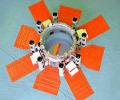
The Indian Space Research Organisation will open 2025 scoring a century orbiting the country's navigation satellite 2,250 kg NVS-02 with its rocket Geosynchronous Satellite Launch Vehicle (GSLV)-F15.

The Chandrayaan-2 mission has made the first-ever observation of the effects of the Sun's Coronal Mass Ejection (CME) on the Moon using its onboard scientific instruments. This observation would help understand the lunar exosphere and the impact of space weather on its surface.
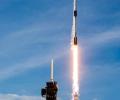
'The solution is to replace, clean up, retest and proceed.' 'There is nothing to worry about if corrected.'

The FAC found that the failure happened when the Geosynchronous Satellite Launch Vehicle rocket's cryogenic engine was to kick in to take the rocket forward.
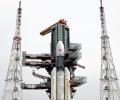
The Indian Space Research Organisation has released the first images of India's heaviest rocket, referred to as "Bahubali" days before it ferries India's Chandrayaan-2 into space. India's most ambitious space mission yet, Chandrayaan-2, which aims to place a robotic rover on the moon, will be launched on July 15 at 2:51 am. Here's all you need to know about the rocket.

The NASA-ISRO NISAR mission has entered its 90-day commissioning phase, involving rigorous checks and calibrations to prepare the satellite for Earth observation. Scientists highlight the collaborative benefits and technological advancements of the mission.

In a jolt to India's space programme on Saturday, the launch of a communication satellite aboard a home-grown vehicle failed after the rocket exploded midair minutes after the lift-off from the spaceport in Sriharikota.

The Department of Space (DoS) plans to realise entirely-built rockets -- GSLV-Mk III and SSLV -- from Indian industry partners, in addition to PSLV, according to a top official of its commercial arm NSIL.
Launch of India's latest communication satellite GSAT-5P onboard homegrown GSLV-F06, powered by Russian cryogenic engine, failed on Saturday when the rocket developed a snag soon after lift-off from the spaceport in Sriharikota.

And the first Indian to go into space from 'Indian soil' could well be a woman.
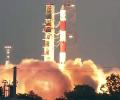
'There's too much coincidence in back-to-back failures of missions critical to national security.'
India on Sunday successfully launched its heavy-duty rocket with indigenous cryogenic engine that placed a communication satellite into the orbit, with Indian Space Research Organisation scientists finally taming the 'naughty boy' GSLV and propelling the country into an elite club of countries.

The Indian Space Research Organisation successfully put India's heavy rocket Geosynchronous Satellite Launch Vehicle-Development 5 (GSLV-D5) into orbit from the spaceport at Sriharikota, Andhra Pradesh at 4.18 pm on Sunday.
A PSLV rocket carrying Earth observation satellite EOS-09 failed to launch from the Sriharikota spaceport early on Sunday.
ISRO officials said that the Rs 330 crore mission failed minutes after the rocket lifted off at 4.27 pm. Although they would go ahead with the same mission next year, it is still considered to be a setback since ISRO had planned on using the GSLV rocket for its second moon mission.
The indigenous rocket will carry the second technology experiment satellite GSAT-2.

'With India's growing capabilities in the space sector, this creates promising opportunities for enhanced collaboration and market access.'

India's heavy-lift rocket GSLV MkIII, carrying communication satellite GSAT-19.
'The work is already on with various data being studied.'
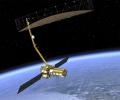
NISAR will not be used for surveillance and will be used to observe the earth.
India's ambitious attempt to flight-test its indigenous cryogenic engine on Thursday received a setback as the homegrown rocket Geosynchronous Satellite Launch Vehicle (GSLV-D3) deviated from path within seconds of lift-off.
Indian Space Research Organisation plans to undertake next month the first developmental flight of a "game-changer" rocket capable of launching four-ton class of satellites from Sriharikota spaceport, says its Chairman A S Kiran Kumar.
The mission is targeted for launch in the fourth quarter of 2024.
'The satellite's condition is healthy.'

GSLV Mark-III will be India's most powerful launch vehicle built to lift the heaviest Indian communications satellites to space.
India's top space scientists will be meeting in Thiruvananthapuram on Saturday to analyse the data and find the cause for failure of GSLV-D3 rocket, which was launched for the first time on Thursday using an indigenously made cryogenic engine.

The 43.43 metre tall rocket lifted off at 5.28 pm from the second launch pad at the Satish Dhawan Space Centre in Sriharikota
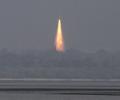
Indian Space agency Indian Space Research Organisation would launch the Geo-synchronous Satellite Launch Vehicle-Mark III (LVM3 X mission) on December 18 which would carry active solid boosters, liquid core stage and a passive cryo-stage.
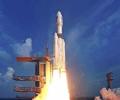
If successful, this would increase capacity to hurl small satellites into space, meeting both local demand and serving global customers.
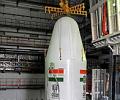
The launch of a Geosynchronous Satellite Launch Vehicle was called off by the Indian Space Reasearch Organisation at the eleventh hour on Monday due to a fuel leak in its second stage -- in a setback to the mission to test its homegrown cryogenic engine -- after its failure three years ago.

India's heaviest rocket ever is expected to take to the sky next January on an experimental flight whose later versions could be used to send humans on space missions.
Indian Space Research Organisation is all set for the launch of the first flight-testing of indigenous cryogenic engine on homespun rocket, Geosynchronous Satellite Launch Vehicle (GSLV-D3), from the Satish Dhawan Space Centre at Sriharikota at 4.27 pm on Thursday.

'We have all the technologies available, but it should be converted to something that can be commercially viable.'
ISRO's vendor policy and quality control processes are under scanner.
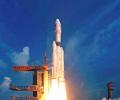
The rocket can put satellites weighing upto four tonnes in space, double the weight that the current GSLV-Mark-II can lift.

Narayanan has a long and distinguished career at ISRO, having played a key role in several important missions, including Chandrayaan-2 and 3, and the Gaganyaan programme.

The heaviest rocket of the Indian Space Research Organisation -- LVM3-M2/OneWeb India-1 -- blasted off from the Sriharikota spaceport on Sunday to place 36 broadband communication satellites into the Low Earth Orbit (LEO) for a UK-based customer.
The Indian Space Research Organisation said that the countdown started at 6.51 am on Sunday.

'Today, when we talk of success of PSLV and GSLV Mk III, we owe it to important inputs that the Prof. Narasimha committee gave'

'When a Project Director is appointed, the whole organization -- including the Chairman ISRO -- works for his success. It is a lesson that has been of abiding value all through the other projects I have worked on,' recalls the late President, one of the earliest pioneers at ISRO.
